The 80% Towing Rule: Why Your Max Capacity is a Marketing Lie
Your truck's tow rating was calculated on a flat test track in perfect conditions with a pro driver. You don't drive on a test track. You drive in crosswinds, up mountain passes, and through traffic. If you're towing at 100% of your rating, you have zero margin for error when things go sideways.
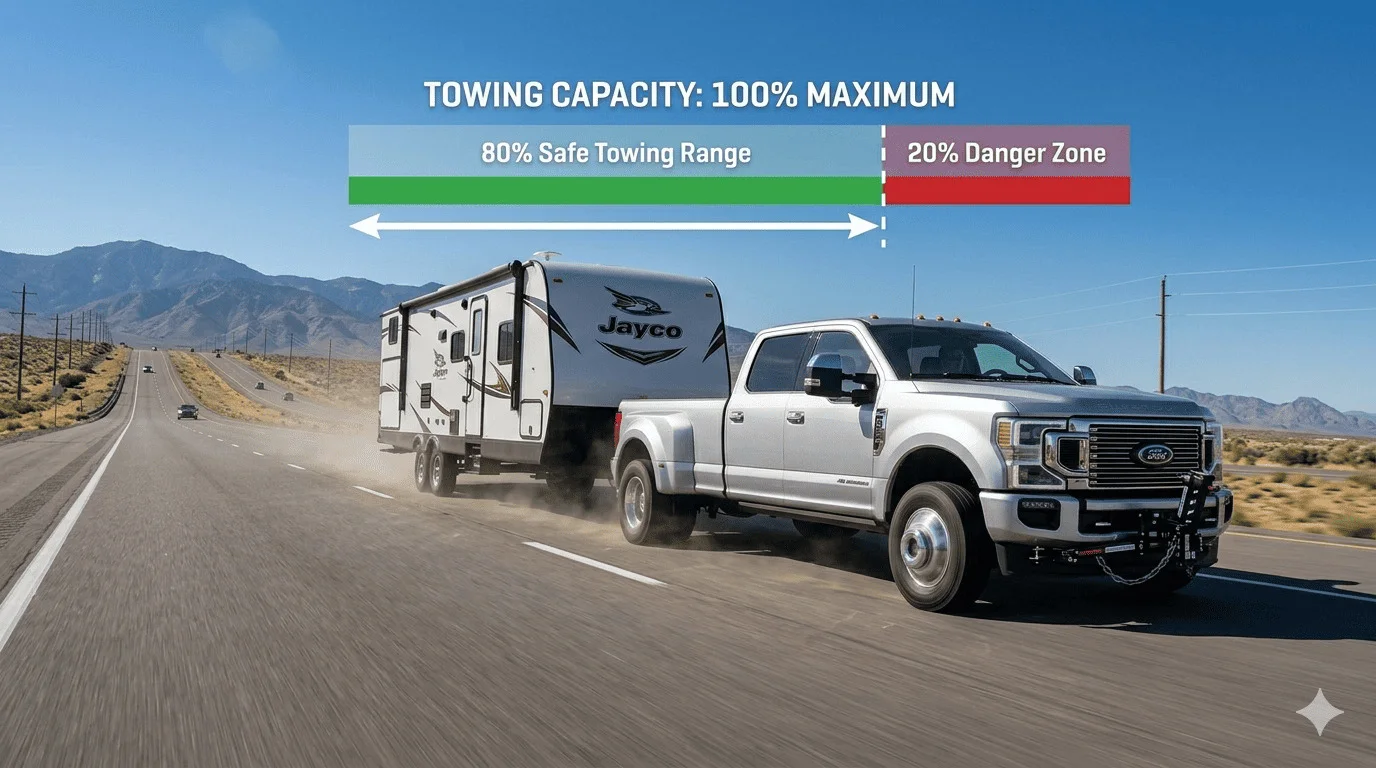
The 80% rule is dead simple: never load your trailer beyond 80% of your truck's maximum rated towing capacity. If the sticker says 10,000 Lbs, treat 8,000 Lbs as your real-world ceiling. That 20% buffer absorbs every variable the manufacturer's test track didn't have — altitude, temperature, wind, grades, and the emergency lane change you didn't see coming.
Run your actual numbers through our towing capacity calculator to see where you stand. Then check your tire pressure — because tires at the edge of their load rating are the first things to fail when you're towing at the limit.
How Manufacturer Tow Ratings Are Tested
The SAE J2807 standard is the protocol most major truck manufacturers follow for towing capacity certification. It requires three specific tests at the truck's claimed maximum tow rating:
The launch test. The truck must launch forward on a 12% grade from a dead stop with the trailer attached at maximum rated weight. This tests the drivetrain's ability to get the rig moving under the worst-case starting condition.
The Davis Dam test. The truck must maintain a minimum speed (typically 40 mph) on a sustained 7% grade for a defined distance while pulling the maximum rated load. This is the sustained heat test — it pushes the transmission, engine cooling, and brakes to their thermal limits.
The braking test. The truck must stop the fully loaded rig from highway speed on a downhill grade within a defined distance. This tests brake capacity under maximum thermal and inertial stress.
The truck that passes these tests is the lightest possible configuration — regular cab, short bed, base engine, one 150 Lb driver, full fuel tank, no options. The moment your truck has a crew cab, a heavier engine, leather seats, four passengers, and a toolbox in the bed, the rig weighs more, and the effective towing capacity drops. But the brochure number doesn't change. That's the lie.
The Three Killers at 100% Capacity
1. Transmission Heat: The Silent Destroyer
Your automatic transmission is a hydraulic system. Transmission fluid does two jobs: it transfers power through the torque converter, and it carries heat away from internal components. When you tow heavy, the torque converter works harder. More work means more heat. More heat means hotter fluid.
Automatic transmission fluid is designed to operate between 175°F and 225°F. Every 20°F above 225°F cuts the fluid's lifespan in half. At 100% towing capacity on a sustained grade, transmission temps can spike to 260-300°F. At that temperature, the fluid breaks down. It loses its lubricating properties. It oxidizes into a brown sludge that clogs the valve body and eats clutch packs.
Even with an aftermarket transmission cooler — which every tow rig should have — towing at 100% on a mountain grade keeps the fluid at the ragged edge of its operating window. At 80%, the torque converter runs with less slip, generates less heat, and the cooler has enough capacity to keep temps in the safe zone. That 20% reduction in load translates to a 30-40% reduction in thermal stress on the transmission.
A transmission rebuild on a modern truck runs $3,500-$7,000. The 80% rule is the cheapest transmission insurance you'll ever buy.
2. Brake Fade: When Stopping Becomes Optional
Brakes convert kinetic energy into heat. The heavier the rig, the more kinetic energy, the more heat. At 100% GCWR coming down a 6% grade, your brakes are dumping enormous amounts of thermal energy into the rotors and pads. The rotors glow. The pads overheat. The brake fluid — which is hygroscopic and absorbs moisture over time — approaches its boiling point.
When brake fluid boils, it creates gas bubbles in the brake lines. Gas compresses. Hydraulic fluid doesn't. Your brake pedal goes soft. Then it goes to the floor. That's brake fade. You're now piloting a 15,000 Lb rig down a mountain with no brakes.
| Component / Factor | At 80% Capacity | At 100% Capacity |
|---|---|---|
| Transmission Fluid Temp (7% grade) | 195–220°F (safe zone) | 250–300°F (degradation zone) |
| Brake Rotor Temp (6% descent) | 400–550°F (normal) | 700–900°F (fade risk) |
| Stopping Distance (60→0 mph) | ~220 ft (manageable) | ~300+ ft (extended) |
| Engine Load (sustained climb) | 70–80% throttle | 95–100% throttle (no reserve) |
| Emergency Swerve Margin | Buffer for correction | Zero margin — loss of control risk |
| Torque Converter Slip | Minimal — fluid stays cool | High — peak heat generation |
| Tire Heat (rear, highway speed) | Within load rating | At or near max load rating |
| Headwind / Crosswind Tolerance | Absorbable | Tips over the edge |
At 80% capacity, the brakes have 20% less kinetic energy to absorb on every stop and every descent. Rotors run cooler. Pads last longer. Fluid stays below its boiling point. You have stopping power when you need it — not just on the first stop, but on the tenth stop at the bottom of a 12-mile mountain descent.
3. The Altitude Factor: Your Engine Shrinks at Elevation
Internal combustion engines breathe air. Thinner air means less oxygen per cylinder fill. Less oxygen means less combustion. Less combustion means less power. The math is brutal: naturally aspirated engines lose approximately 3% of their rated horsepower for every 1,000 feet of elevation gain.
I-70 through Colorado hits the Eisenhower Tunnel at 11,158 feet. At that elevation, a naturally aspirated gas engine has lost roughly 33% of its sea-level horsepower. Your 400 HP V8 is now producing about 268 HP. If you were towing at 100% of your rated capacity — a rating certified at or near sea level — your engine is now underpowered for the load by a third.
Turbocharged and diesel engines handle altitude better because the turbocharger compensates for thinner air by forcing more of it into the cylinders. But even turbos lose efficiency above 8,000 feet. And the turbo itself runs hotter at altitude because it's working harder to maintain boost pressure.
At 80% of rated capacity, your engine still has enough reserve power at altitude to maintain speed, pull grades, and respond to emergency maneuvers. At 100%, you're the slow-moving obstacle in the right lane, engine screaming, transmission hunting between gears, brakes smoking on every descent.
This isn't theoretical. Drive I-70 westbound from Denver in July and you'll see it — overloaded rigs pulled over on the shoulder with hoods up and steam pouring out. Every single one of them thought the brochure number was the real number. It's not. The brochure number is the sea-level, flat-road, perfect-weather number. The real number is 80% of that.
What the 80% Rule Actually Buys You
Emergency Maneuver Capacity
A truck towing at 100% capacity has no reserve. Every ounce of braking, engine power, and tire grip is spoken for. When a car cuts you off, when a tire blows, when an animal runs into the road — you need reserve capacity to react. Braking reserve. Steering reserve. Engine power to accelerate out of a closing gap.
At 80%, that reserve exists. The brakes can handle a panic stop without fading. The engine can accelerate to avoid a merging vehicle. The tires have enough grip margin to hold a lane change without the trailer swapping ends. That 20% buffer isn't wasted capacity — it's survival capacity.
Component Longevity
Trucks that tow at 80% consistently outlast trucks that tow at 100%. Transmissions last 50,000-100,000 miles longer because the fluid stays in its operating window. Brakes go 30-40% further between replacements. Rear axle bearings and seals don't overheat. Exhaust manifold bolts don't warp. Cooling system hoses don't get cooked.
The 80% rule isn't just a safety margin — it's an ownership cost reduction strategy. The truck you're driving at 80% load is the truck that still has a functioning transmission at 200,000 miles. The one you're driving at 100% is the one getting a rebuild at 120,000.
Driver Fatigue Reduction
This one doesn't show up in engineering specs, but it's real. A rig at 100% capacity is physically harder to drive. The steering is heavier. The brakes need more pedal pressure. The engine is louder because it's working harder. Lane changes are more deliberate. Every hill requires more planning. Every descent requires more concentration.
After three hours of that, you're tired. After six hours, you're making mistakes. Fatigue is a factor in over 10% of towing-related accidents. A rig at 80% capacity drives easier, steers lighter, stops shorter, and lets you arrive at the campsite with enough mental energy to back the trailer in without hitting the picnic table.
The Formula
The math is simple enough to do on a tailgate with a pen:
If your truck's specific tow rating is 12,000 Lbs, your 80% ceiling is 9,600 Lbs. Load the trailer at or below 9,600 Lbs total — not dry weight, total loaded weight including water, propane, cargo, everything. Verify on a CAT scale. If you're over 9,600 Lbs, something comes off the trailer.
If you're buying a truck specifically for towing, size the truck so that your intended trailer weight falls at or below 80% of the truck's max tow rating. Buying a truck that can "just barely" pull your trailer means you're buying a truck that will tow at 100% every trip. That's buying a future rebuild.
When the 80% Rule Matters Most
Mountain Passes
Any route above 5,000 feet with sustained grades over 5%. I-70 in Colorado. I-80 through the Donner Pass. I-15 through the Virgin River Gorge. US-93 through Boulder City. These are the roads that separate properly loaded rigs from overloaded ones. The NHTSA towing crash data shows a disproportionate number of towing-related accidents on mountain grades — most involving rigs at or above their rated limits.
Summer Heat
Ambient temperatures above 90°F reduce your cooling system's ability to reject heat. The engine runs hotter. The transmission runs hotter. The tires run hotter. Everything that generates thermal stress under towing load generates more of it when the ambient air is already hot. A rig that's fine at 80% in April can overheat at 100% in July on the same road.
Headwinds
A 20 mph headwind increases aerodynamic drag on a travel trailer by roughly 30-40%. That's not a guess — it's physics. The flat face of a travel trailer is a wall. Wind pushes against it. The engine has to produce more power to maintain speed against that push. At 100% towing capacity, the engine is already maxed. A headwind tips it over the edge. At 80%, the engine has reserve power to absorb the additional drag.
Long Hauls
A 30-minute tow to the lake is not the same as a 6-hour highway haul. Sustained towing generates sustained heat. Components that run cool on a short trip accumulate thermal stress on a long one. The 80% rule matters more the longer you drive. A weekend trip across two states with a loaded trailer is exactly the scenario where that 20% buffer keeps everything in the safe zone.
The manufacturer's max tow rating is a legal certification number. It tells you what the truck can do in a lab. The 80% rule tells you what the truck can do on the road, in the real world, when it's hot, uphill, windy, and the driver ahead of you just slammed on their brakes. One number sells trucks. The other keeps people alive. Pick the one that matters.
Frequently Asked Questions
No. The 80% rule is not a federal or state law. It's an industry best practice followed by experienced towers, fleet managers, and RV safety organizations. No agency will cite you for towing at 100%. However, if you're in an accident while towing at the limit in adverse conditions, the investigation will examine whether the load contributed. Insurance adjusters know the difference between margin and edge. The 80% rule exists because physics doesn't care about your window sticker.
Yes, but diesel trucks handle sustained loads better due to higher low-end torque and typically larger transmission coolers. A diesel at 90% generates less thermal stress than a gas engine at 90%. That said, diesels still lose power at altitude, experience brake fade on descents, and have finite GCWR limits. Diesel owners tend to overload more because the truck "feels fine" — the engine hides the stress that the brakes and transmission are absorbing. The 80% buffer is still the right call for mountain passes, headwinds, and hot weather.
Every drivetrain component operates at its engineering ceiling. The transmission runs at peak heat. Brakes work at full duty cycle. The engine holds max torque through every gear change. On a flat road in mild weather, it works. Add a 6% grade, 95°F heat, a headwind, or an emergency maneuver, and there's no buffer. Transmission fluid overheats. Brake pads glaze. The engine can't hold speed on climbs. The 80% rule gives you room for the variables the test track never had.
Take your truck's specific max tow rating (from the door sticker or manufacturer spec for your exact configuration, not the brochure max for the base model) and multiply by 0.80. A 10,000 Lb rating becomes an 8,000 Lb target. Load the trailer at or below that number — total loaded weight including water, propane, cargo, everything. Verify on a CAT scale. The 20% buffer absorbs altitude, temperature, wind, grades, and the situations the test track never tested.