How to Weigh Your Rig on a CAT Scale: Stop Guessing Your Payload
If you're relying on your truck's brochure for your towing numbers, you're towing blind. The only number that matters is the one the scale gives you. Here's how to get it without looking like an amateur at the truck stop.
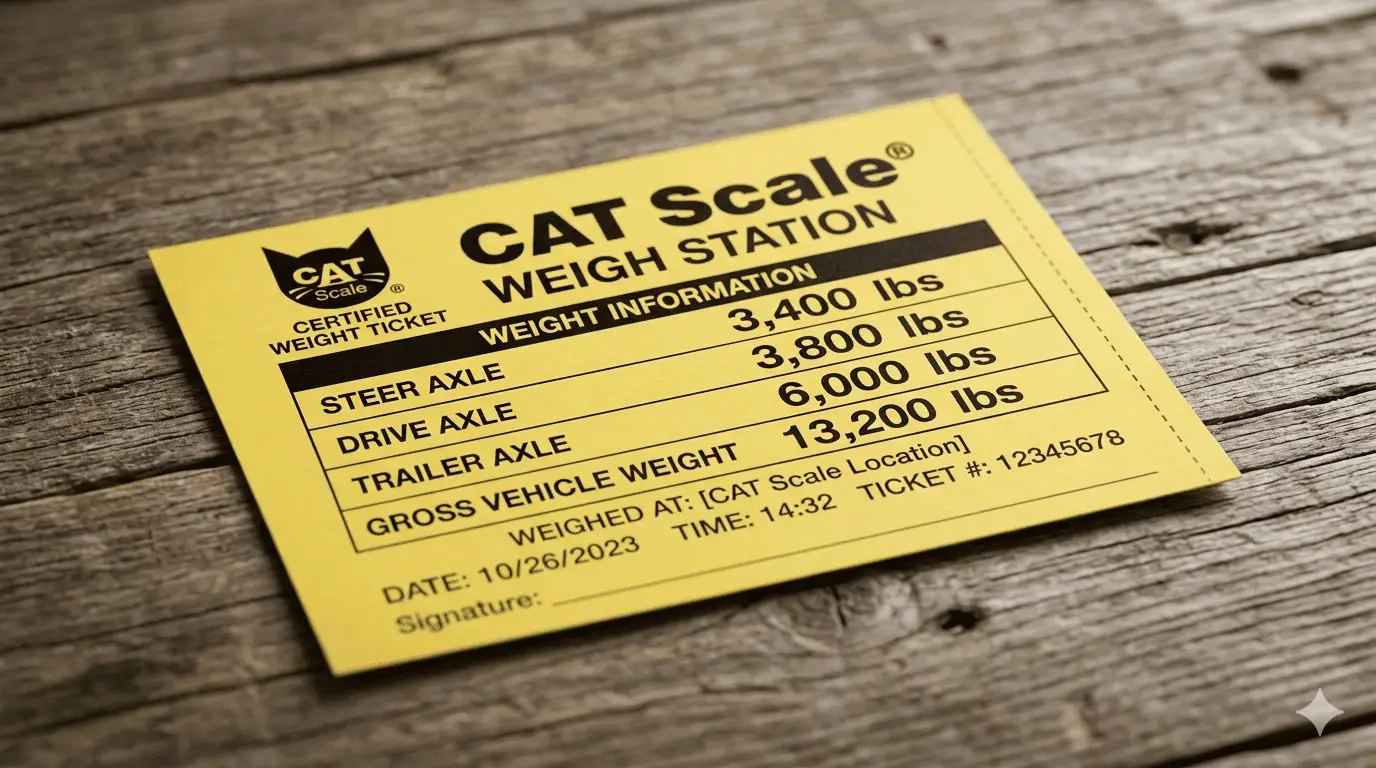
A CAT scale is a certified platform scale found at most major truck stops across the country — Pilot, Flying J, Love's, TA. It gives you individual axle weights and a gross combined weight in about two minutes. It costs $13.50 for the first weigh and $2.00 for a re-weigh. For less than the price of a gas station sandwich, you get the three numbers that decide whether your rig is safe or overloaded: steer axle weight, drive axle weight, and trailer axle weight.
Those numbers feed directly into every calculator on this site. Your towing capacity starts with GCWR — the gross combined weight of the entire rig. Your net payload depends on what the truck actually weighs versus its GVWR. And your trailer tongue weight — the number that determines whether your trailer tracks straight or fishtails — can only be measured accurately on a scale. Everything starts here.
What You Need Before You Pull In
Your truck's GVWR. This is on the Federal Certification Label — the yellow and white sticker on your driver-side door jamb. Write it down before you leave home.
Your truck's GAWR (front and rear). Also on the door sticker. These are the individual axle weight limits. You'll compare your scale readings against these numbers.
A pen, or the Weigh My Truck app. CAT Scale has a free app that stores your weight slips digitally. It's faster than keeping paper tickets in the glovebox and it lets you compare weigh-ins over time.
A full tank of fuel. Weigh with the fuel level you'll tow with. A full tank of diesel on a 3/4-ton truck adds 150-200 Lbs. If you weigh half-empty and tow full, your real weight is higher than the slip says.
Load the truck and trailer exactly the way you plan to tow. Passengers in the cab. Gear in the bed. Coolers loaded. Water tanks filled. Propane tanks in the trailer. If it's going to be on the rig when you hit the highway, it needs to be on the rig when you hit the scale.
The 3-Step Weighing Process
First Weigh — Truck + Trailer Together (Fully Loaded)
Pull onto the CAT scale with your entire rig connected. Position the truck's steer axle (front) on Platform 1, the drive axle (rear) on Platform 2, and the trailer axle(s) on Platform 3.
If you have a tandem-axle trailer, both trailer axles go on Platform 3. If you're pulling a fifth-wheel, the steer axle goes on Platform 1, the drive axle (with pin weight on it) goes on Platform 2, and the trailer tandems go on Platform 3.
Go inside. Tell the clerk you need a weigh. Pay $13.50. Collect your weight slip. It'll show three numbers: Platform 1 (steer), Platform 2 (drive), Platform 3 (trailer), plus the gross combined weight of the whole rig.
Second Weigh — Truck Only (Trailer Disconnected)
Find a safe, flat spot in the truck stop lot. Disconnect the trailer. Chock the trailer wheels, drop the tongue jack or landing gear, and pull the truck away.
Drive the truck alone back onto the scale. Steer axle on Platform 1. Drive axle on Platform 2. Platform 3 stays empty. Go inside and ask for a re-weigh — it's $2.00.
Collect the second slip. This shows your truck's actual weight without any tongue weight or pin weight from the trailer. The drive axle number on this slip is critical — it's the baseline you'll subtract from.
The Math — Calculate Tongue Weight and Real Payload
Now you have two weight slips. Here's where the real numbers come out.
That's it. The difference between the drive axle weight with the trailer connected and without the trailer connected is the tongue weight. The trailer's tongue pushes down on the hitch, which loads the drive axle. Remove the trailer, the load disappears. The delta is your tongue weight.
Your GVWR minus the truck's actual gross weight (from Weigh 2) gives you the total payload capacity. Now subtract the tongue weight from Weigh 1 to see how much payload is left for passengers and cargo after the trailer is hooked up.
Reading Your Weight Slip
A CAT scale ticket isn't complicated once you know what each line means. Here's a breakdown of a typical slip from a half-ton truck pulling a travel trailer:
From those two tickets:
That 820 Lbs is the actual tongue weight of the trailer. It's a real measured number — not a guess, not 12% of the brochure weight, not what the trailer dealer told you. Eight hundred and twenty pounds sitting on the drive axle through the hitch receiver.
If the truck's GVWR is 7,200 Lbs and the truck-only gross was 6,840 Lbs, the remaining payload capacity is 360 Lbs — and the tongue weight alone is 820 Lbs. This rig is overloaded by 460 Lbs. The driver wouldn't know without the scale.
Where to Find a CAT Scale
CAT scales are at over 2,800 locations across the US and Canada. The fastest way to find one near you is the CAT Scale Locator. Punch in your zip code and it'll show the nearest truck stops with certified scales. Most Pilot, Flying J, Love's, and TA Travel Centers have them.
You can also download the Weigh My Truck app (available on iOS and Android). It stores your weight slips digitally, lets you pay from the cab, and keeps a history of every weigh-in. Worth having on your phone if you tow more than twice a year.
Common Mistakes at the Scale
Weighing with a half-empty fuel tank
If you're going to tow with a full tank, weigh with a full tank. A full tank of diesel in a 3/4-ton adds 160-200 Lbs. That's 160 Lbs of payload that won't show on the slip if you weigh half-empty.
Not positioning axles correctly on platforms
The scale has three platforms for a reason. If your drive axle sits between Platform 1 and Platform 2, the reading splits between them and neither number is accurate. Pull forward slowly and watch your mirrors. The platform edges are usually painted. Some locations have a spotter light system.
Weighing without passengers and gear
If you're going to tow with four adults in the truck and 200 Lbs of gear in the bed, weigh with four adults and 200 Lbs of gear. The scale tells you what the rig weighs right now. If "right now" doesn't match how you actually tow, the numbers are useless.
Skipping the second weigh
A lot of people do one weigh with the trailer and call it done. You get the gross combined weight, but you don't get tongue weight. The tongue weight calculation requires two weighs — one with the trailer, one without. That $2 re-weigh is the most important $2 you'll spend all year.
What to Do With Your Numbers
Once you have your weight slips, run them through the TowingLogic calculators to see exactly where you stand:
Check total combined weight against GCWR. If your Weigh 1 gross exceeds your truck's Gross Combined Weight Rating, the whole rig is over the engineering limit. Something has to come off the trailer or out of the truck.
Check each axle against its GAWR. Compare the steer axle and drive axle numbers from your slips against the GAWR Front and GAWR Rear on your door sticker. You can be under GVWR total and still overload a single axle. The NHTSA towing safety standards flag individual axle overloading as a top cause of towing-related crashes.
Verify tongue weight is in the safe range. For a bumper-pull trailer, tongue weight should be 10-15% of total trailer weight. For a fifth-wheel, 15-25%. If your tongue weight is below those floors, the trailer is tail-heavy and prone to sway. Plug your numbers into the tongue weight calculator to check.
Confirm remaining net payload. GVWR minus truck-only weight gives you max payload. Subtract tongue weight, passengers, and cargo from that number. If the result is negative, you're overloaded — end of story. Run it through the payload calculator to see the breakdown.
A CAT scale weigh-in costs $15.50 total for both weighs. It takes 15 minutes including the time to unhook and rehook the trailer. That's less than the price of lunch and less time than an oil change. And it gives you the only numbers that actually matter for towing safety. Do it before every major trip. No excuses.