P-Metric vs. LT Tires for Towing: Why Your Stock Tires Are the Weakest Link
The tires that came on your half-ton truck from the factory were chosen for one reason: a quiet, car-like ride. They were never meant to handle the lateral stress of a 7,000 Lb trailer in a crosswind. If your sidewalls are "squishing" under load, you're one pothole away from a blowout.
Most half-ton trucks — F-150, Ram 1500, Silverado 1500, Tundra — roll off the lot wearing P-Metric tires. The "P" stands for Passenger. These tires are built for commuting: thin sidewalls tuned for comfort, low rolling resistance for fuel economy, and just enough load capacity to cover the truck's curb weight plus a few passengers. They were never engineered for sustained heavy loads, tongue weight on the rear axle, or three hours of highway towing in July heat.
If you tow anything over 5,000 Lbs on a regular basis, you need to understand the difference between P-Metric and LT tires — because that difference is the gap between a safe trip and a shredded sidewall on the shoulder of I-10. Check your towing tire pressure guide to see how load changes the PSI equation, and run your truck payload capacity numbers to know exactly how much weight those rear tires are carrying.
The Quick Identification Table
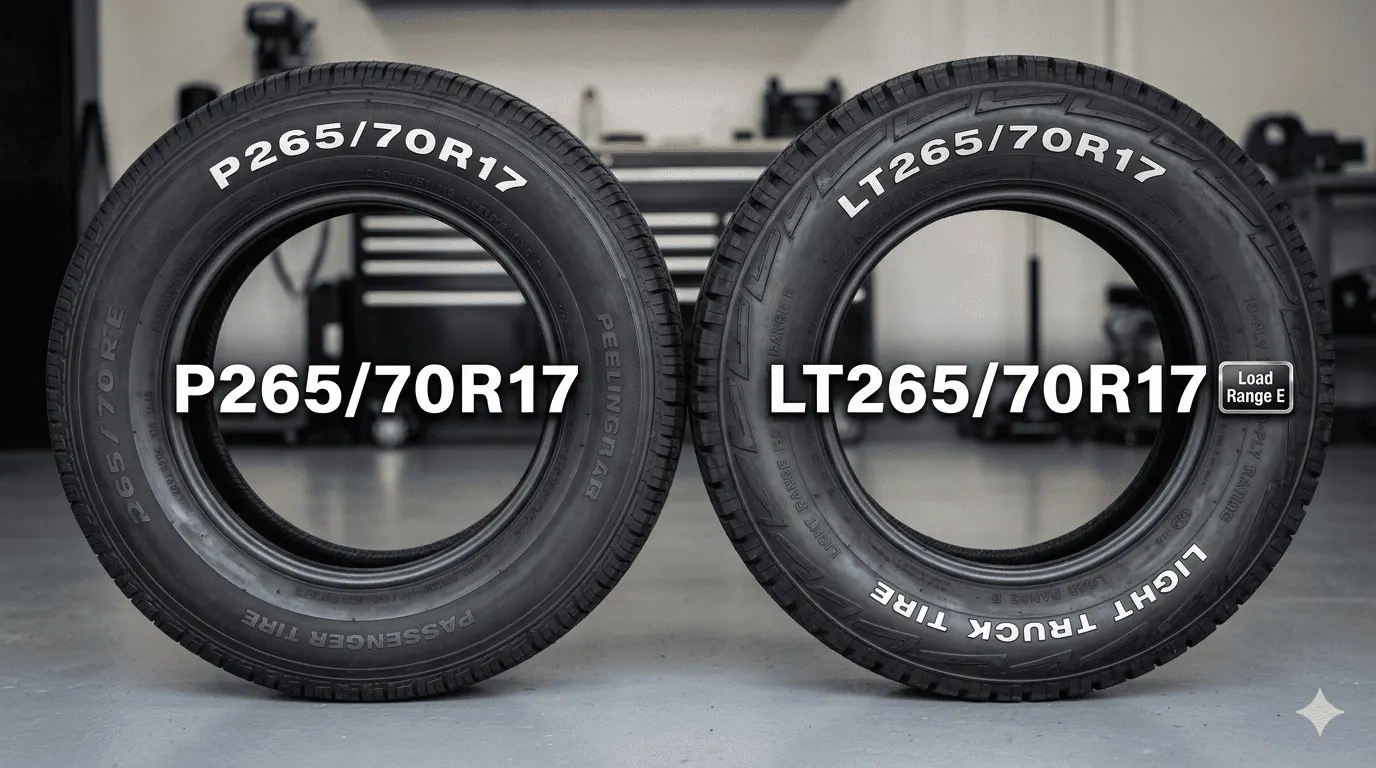
Here's how to spot the difference on the sidewall and what it means for your rig under towing loads:
| Spec | P-Metric (Passenger) | LT (Light Truck) |
|---|---|---|
| Sidewall Marking | Starts with "P" (e.g., P265/70R17) | Starts with "LT" (e.g., LT275/70R18) |
| Ply Rating | 2–4 ply (thin sidewall) | 6–10 ply (reinforced) |
| Typical Load Range | SL (Standard Load) or XL | C, D, or E |
| Max Cold PSI | 35–51 PSI | 50–80 PSI |
| Max Load Per Tire (typical 275/70R18) | ~2,535 Lbs at 51 PSI | ~3,195 Lbs at 80 PSI |
| Sidewall Stiffness Under Load | Soft — visible flex/bulge | Firm — minimal deflection |
| Heat Tolerance (Sustained Tow) | Moderate — fails after 1-2 hrs at limit | High — built for all-day heavy loads |
| Ride Quality (Empty/Daily) | Smooth, quiet | Slightly firmer, more road feedback |
| Towing Suitability | Light towing only (<3,500 Lbs) | Built for towing (5,000+ Lbs) |
P-Metric: Why "Passenger" Tires Fail Under Towing Loads
A P-Metric tire has a 2-ply or 4-ply sidewall. That sidewall is designed to flex — on purpose. The flex absorbs road imperfections and delivers the smooth, quiet ride that truck buyers expect on a test drive. At curb weight, it works beautifully. The tire runs cool, wears evenly, and costs less than an LT alternative.
Now add 800 Lbs of tongue weight to the rear axle. Each rear tire is now carrying 400 Lbs more than it did on that test drive. The sidewall — designed for flex — flexes more. A lot more. That flex is visible. Stand behind your loaded rig and look at the rear tires. If the sidewall is bulging outward below the tread line, the rubber is deforming beyond its design intent. That bulge has a name in the tire industry: sidewall squish.
Every rotation of a squished sidewall generates internal heat. The rubber and steel belts bend in, then push back out, hundreds of times per mile. That mechanical cycling converts kinetic energy into thermal energy inside the tire carcass. At 35 PSI and 1,200 Lbs of load, the heat is manageable. At 35 PSI and 2,000 Lbs of load — which is where many half-ton tow rigs land on the rear tires — the heat exceeds the rubber's design threshold.
Once the internal temperature crosses that threshold, the bond between the steel belts and the rubber compound weakens. The tread starts to separate from the carcass. Sometimes it peels slowly — you'll see chunks of tread on the shoulder. Sometimes it goes all at once — a violent blowout at highway speed with zero warning. That's the shredded rubber you dodge on every interstate in America.
P-Metric tires are rated with a 10% load derating for towing applications. The U.S. Tire Manufacturers Association (USTMA) recommends reducing a P-Metric tire's published max load by 10% when used for sustained trailer towing. That means a tire rated at 2,535 Lbs should be treated as a 2,280 Lb tire when towing. Most people don't know this derating exists. Most dealerships don't mention it either.
LT Tires: Built for the Weight You're Actually Carrying
An LT tire is a fundamentally different structure. Where a P-Metric uses 2-4 plies, a Load Range E LT tire uses a 10-ply equivalent construction. The sidewalls are thicker, stiffer, and reinforced with additional nylon or polyester layers. They don't flex under heavy loads — they resist deflection, maintain their shape, and run cooler because there's less mechanical cycling per revolution.
That sidewall stiffness is everything when you're towing. A stiff sidewall means the tire maintains its designed contact patch with the road. The tread sits flat. The truck tracks straight. Steering response stays sharp because the tire isn't squirming under lateral forces.
The "Squirm" Factor
Tread squirm is what happens when a soft tire deforms under load and the tread blocks shift laterally against the road surface. It feels like the truck is "wandering" — slight vagueness in the steering, a tendency to drift in the lane, the sensation that the trailer is nudging the rear of the truck around corners. Experienced towers call it "the trailer steering the truck."
Squirm comes from sidewall flex. A soft sidewall allows the tread to move independently of the wheel. Under heavy rear axle loads — especially with tongue weight pushing the rear down — each rear tire is deforming slightly with every road imperfection, every steering input, every crosswind gust. LT tires eliminate squirm because the sidewall holds the tread in position. The contact patch stays consistent. The truck goes where you point it.
Heat Dissipation: The Engineering Gap
LT tires dissipate heat better for two reasons. First, the stiffer sidewall generates less heat per rotation because there's less flex. Less mechanical work means less thermal output. Second, LT tires are designed to run at higher pressures — 65 to 80 PSI for Load Range D and E. Higher pressure means less deflection, which means less heat, which means longer tire life and lower blowout risk under sustained loads.
A P-Metric tire maxes out at 44-51 PSI. At that pressure under heavy towing loads, the tire is already at its thermal limit. An LT tire at 65 PSI under the same load is cruising well within its operating range. The math isn't close.
Which LT Tire Pattern for Towing?
Highway Terrain (H/T)
Straight rib pattern. Quiet on pavement. Lowest rolling resistance of LT options. Best for towers who stick to paved highways and want maximum fuel economy. Examples: Michelin Defender LTX, Continental TerrainContact H/T.
All-Terrain (A/T)
Aggressive tread with open channels. Handles gravel, dirt, and wet pavement. Slightly more road noise and rolling resistance. Best for towers who also go off-road — boat ramps, campgrounds, forest roads. Examples: BFGoodrich KO2, Falken Wildpeak AT3W.
For pure towing on paved roads, the highway rib pattern is the better choice. It runs cooler, wears slower, and gets 1-2 mpg better fuel economy versus an aggressive all-terrain. But if your campsite is at the end of a gravel road or you launch a boat on a muddy ramp, the all-terrain gives you the grip you need without sacrificing much in load capacity.
Regardless of pattern, make sure the LT tire's load rating exceeds your actual per-tire weight with a margin. Check your loaded rear axle weight on a CAT scale, divide by two, and compare that number to the tire's max load at your chosen PSI. Use our towing tire pressure guide to calculate the exact PSI for your axle load. For manufacturer-specific load-inflation data, the Toyo Tire Load-Inflation Tables provide detailed charts across all load ranges.
The Upgrade Path: What to Buy
Same Size, Higher Load Range
The simplest upgrade is swapping your P-Metric tires for LT tires in the same wheel diameter. If your truck came with P275/65R18, look for LT275/65R18 in Load Range E. The tire fits the same wheel. No modifications needed. You gain 30-40% more load capacity and a sidewall that can handle real towing weight.
Sizing Considerations
LT tires in the same size code are sometimes slightly wider or taller than their P-Metric equivalent due to the thicker sidewall. Check the tire's actual dimensions against your truck's wheel well clearance, especially if you've added a leveling kit or aftermarket suspension. Most stock trucks have no clearance issues — the manufacturers build in margin.
What About "XL" P-Metric Tires?
Some P-Metric tires carry an "XL" (Extra Load) designation. These have slightly higher max PSI (typically 50-51 PSI vs 44 PSI for standard load) and a marginally higher load rating. They're better than standard P-Metric for light towing, but they still have the same thin sidewall construction. XL is a band-aid. LT is the fix.
The cost difference between a set of four P-Metric tires and four LT Load Range E tires is typically $200-$400. A roadside blowout with a trailer attached costs $300 minimum for the emergency tire change, plus whatever the tow truck charges if the rig ends up in the ditch. That's before you factor in a wrecked fender, a bent axle, or the medical bills if it rolls. The LT upgrade pays for itself the first time it prevents a failure that P-Metric tires wouldn't have survived.
If you tow over 5,000 Lbs more than twice a year, ditch the P-Metric rubber. Get LT Load Range E tires. Set pressure based on your actual loaded axle weight. Check pressure cold before every trip. That's the whole program. It's not complicated. It's not expensive. And it's the single biggest safety upgrade you can make to a tow rig without touching the engine or suspension.
Frequently Asked Questions
You can, with serious limits. P-Metric tires have thinner sidewalls, lower ply ratings, and less load capacity than LT tires. For light towing under 3,500 Lbs with minimal tongue weight, they can work if inflated to max cold PSI. For anything over 5,000 Lbs — especially sustained highway towing — P-Metric tires overheat and risk catastrophic sidewall failure. If you tow regularly, switch to LT.
Load Range E indicates a 10-ply equivalent construction with a max cold pressure of 80 PSI. These tires carry 3,000-3,750 Lbs per tire at max pressure. The higher ply count means stiffer sidewalls, less flex under load, and better heat dissipation during extended highway towing. Load Range E is the standard recommendation for half-ton and three-quarter-ton trucks that tow regularly.
Check the first characters of the tire size on the sidewall. P-Metric tires start with "P" (e.g., P265/70R17). LT tires start with "LT" (e.g., LT275/70R18). Some tires have no prefix — those are Euro-metric and typically match P-Metric load capacity. If your tires start with P and you tow over 5,000 Lbs, you're on the wrong rubber.
Slightly. LT tires have stiffer sidewalls that transmit more road feedback. The ride is firmer, noise is marginally higher, and steering feels heavier at low speed. Most drivers adapt within days. The tradeoff: a tire that actually carries the load without overheating and delaminating. A slightly firmer daily ride is a small price for a tire that won't blow out at 65 mph with a trailer attached.